Marketing project management is planning the work, splitting the roles, coordinating every party and measuring results so a project hits its KPIs on time and within budget. I do it in four steps: write a project charter, choose the agency, run the parallel workstreams, then measure and close the project.
A nationwide event series has a lot happening at once: the agency, gifts, POSM (point-of-sale materials), schedules with retail partners, reports to management. I led a project like this at a multinational consumer-goods company in Vietnam: a battery trade-in programme where shoppers brought old batteries to the store and got new ones, about 20 events over 6 months. The team included one lead agency, one in-house digital team, the regional marketing office, retail partners and several internal departments.
Figures are for illustration only, not actual data.
This article is for in-house marketers and small business owners who coordinate an agency or many tasks at the same time. At the end you can download an Excel template with a charter, a RACI chart, a weighted KPI score, a risk register and a tracker. It works even if you don’t have an agency.
Key takeaways
- Start with a project charter: goals, KPIs and their weights, budget, milestones, stakeholders, scope and who approves.
- Use a RACI chart to split roles: who does the work, who is accountable, who is consulted, who is informed. One “A” per task.
- Choose an agency with a clear brief and weighted scoring criteria. Price is not the deciding factor.
- When many workstreams run in parallel, use a hybrid approach (Waterfall for the overall frame, Agile for online communication) and schedule around the critical path.
- Real example: a 20-event battery trade-in series in Vietnam, from the RACI chart to what I did when shoppers didn’t show up.
What is marketing project management?
Marketing project management is how you take a piece of marketing work with a clear start and end to its goal. A marketing project has its own start date, end date, budget and KPIs: an event, a product launch or a series of brand activations.
That makes it different from ongoing work like posting on social media every day. Because a project ends, everyone needs one shared summary to look at. That summary is the project charter.
TechTarget describes a project charter as a short, formal document that confirms the project exists and gives the project manager authority to start work. In a large company a charter can run several pages; in a small business a few bullet points are enough.
So a charter is more than a summary. It says who leads the project, what they can decide and which resources they can use. It is also different from the implementation plan: the charter approves the direction at a high level, while the implementation plan goes task by task, day by day.
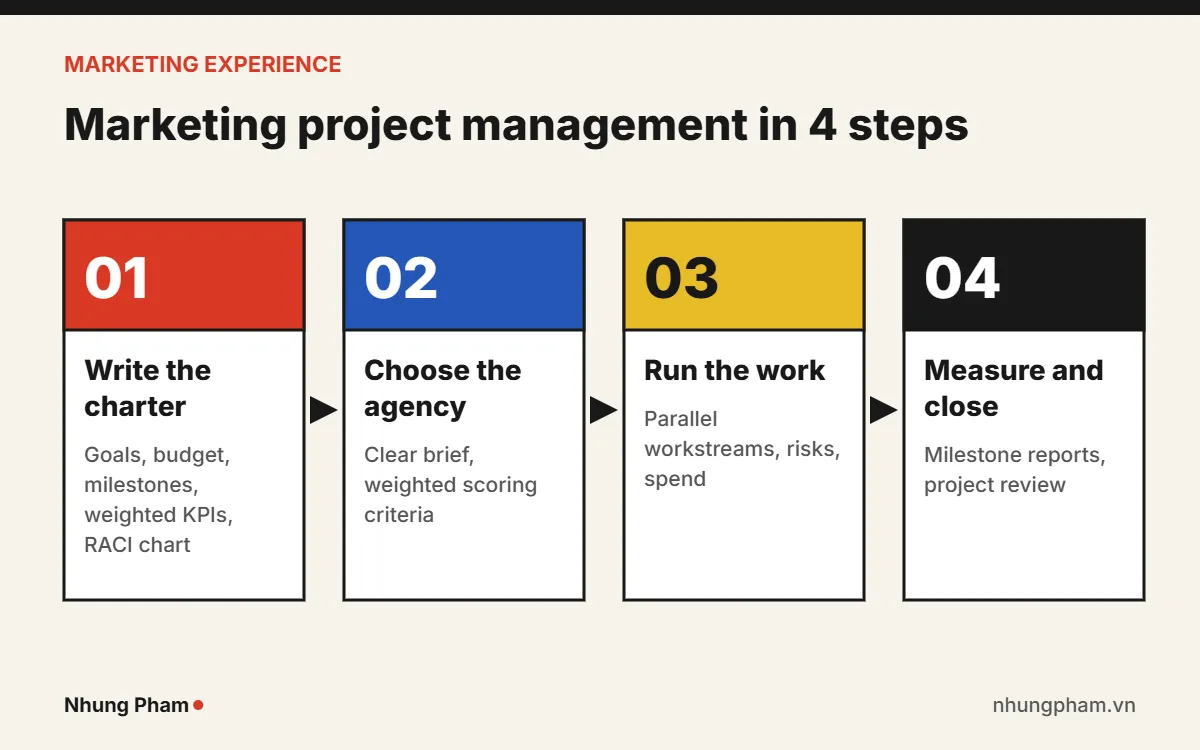
Step 1: What goes into a marketing project charter?
In my view, a charter should answer the 12 items below. For a marketing project I also add the key message; the budget sits under constraints. This is the most important step. Get it right and the project has a solid base to succeed.
| Charter item | What to write |
|---|---|
| 1. Business need | Why this project, and why now |
| 2. Project purpose | What the project exists to achieve |
| 3. Objectives | The KPIs, the target for each and their weights |
| 4. High-level scope | What the project will deliver |
| 5. Out of scope | What the project will not do |
| 6. Key stakeholders | Sponsor, project lead and their decision rights, other parties |
| 7. Assumptions | What you treat as true while planning |
| 8. Constraints | Budget, timeline, resources, compliance |
| 9. Risks | Risks you can already see, detailed in the risk register |
| 10. Milestones | Start date, end date and the main milestones |
| 11. Success criteria | How success is measured: the weighted KPI score and acceptance criteria for deliverables |
| 12. Approval needs | Who must approve the charter before work starts |
Below are the items I see done too quickly most often, with examples from the battery trade-in series.
Goals and the main KPI
A project goal is usually brand awareness or sales. Turn it into a KPI you can measure. For example, “raise awareness” becomes “2,000 people try the product at the events” (illustrative number).
Set KPIs using SMART: Specific, Measurable, Achievable, Relevant and Time-bound. If you have run the activity before, use past results as a benchmark. If it is new, look at results from similar activities.
What if the project has more than one KPI?
A project can have several KPIs. When it does, I give each KPI a weight, and the weights add up to 100%. The KPI with the highest weight is the primary KPI. When things go wrong, the project lead knows which one to protect first.
At the wrap-up, multiply each KPI’s achievement rate by its weight and add them up. The whole project gets one score, instead of each party looking at a different number and reaching a different verdict. I still track a few control metrics, such as cost per attendee, to know what it cost to hit the KPIs.
For events, the primary KPI is often attendance and the secondary KPI is online impressions. Some events do it the other way round. It depends on what the budget owner wants.
In the battery trade-in series, the primary KPI was event attendance and the secondary KPI was social media impressions. When we couldn’t hit both, I protected attendance. Here is how the scoring works:
| KPI | Weight | Target | Actual | Achievement | Score (achievement × weight) |
|---|---|---|---|---|---|
| Event attendees (primary KPI) | 70% | 8,000 | 7,200 | 90% | 63 |
| Social media impressions (secondary KPI) | 30% | 2,000,000 | 2,400,000 | 120% | 36 |
| Project score | 100% | 99 |
Figures are for illustration only, not actual data.
Agree at the start whether over-achievement is capped, for example at 120% per KPI (a suggestion, not an industry standard). That way one KPI far above target can’t hide a primary KPI that missed.
Message, budget and milestones
- Message: the project’s key message, taken from the brand’s messaging framework. It can be rational (what the product does) or emotional (how customers feel using it).
- Budget (under constraints): write the actual number, for example VND 1 billion (illustrative). Keep a contingency for surprises; how much depends on the project. That is a suggestion, not an industry standard.
- Timeline and milestones: a project needs an end date. Whether it hits its targets or not, everyone then has a point to evaluate and decide what comes next.
Stakeholders and the RACI chart
Stakeholders usually include the CEO, marketing and sales, and sometimes finance, legal and logistics. In a multinational there is often a regional marketing office at the regional headquarters (RHQ) that advises on strategy and communication. Bring the RHQ in when you write the charter, not after the concept is finished.
From experience, agree on what each decision-maker expects from the project at the very start. You want to avoid the situation where marketing and the CEO agree, the project is delivered, and only then does Sales say no.
To split roles, I use a RACI chart (also called a RACI matrix, or responsibility assignment matrix):
- R (Responsible): the person who does the work.
- A (Accountable): the person who owns the outcome. Each task has only one A.
- C (Consulted): people asked for input before a decision.
- I (Informed): people who receive updates.
The chart shows who does what, who decides, and who gets weekly, monthly or end-of-project reports. Nobody misses information, work isn’t duplicated, and people who don’t need an update don’t get one. For confidential projects RACI is not enough: add a non-disclosure agreement (NDA) and file access controls.
On my project, the department heads agreed on the split first, and then the person paying for the project signed off the RACI chart; for this series that was the CEO. Legal, supply chain and customer service (who handled the collected batteries) did their own part of the work (R), but Marketing stayed accountable (A), because Marketing owned the schedule and operations of the whole project. For reporting, the agency and the digital team sent the numbers and Marketing consolidated them. Here is an illustrative chart:
| Task | Marketing | Lead agency | In-house digital | Sales | Retail partners | Legal / Supply chain | Customer service | RHQ | CEO |
|---|---|---|---|---|---|---|---|---|---|
| Approve charter, budget, RACI | R | – | – | C | – | – | – | C | A |
| Design concept | A | R | C | I | – | – | – | C | I |
| POSM production | A | R | – | I | C | – | – | – | – |
| Content, online communication | A | C | R | – | – | – | – | C | I |
| Offline communication | A | R | – | C | C | – | – | C | – |
| Retail partner coordination | A/R | C | – | C | C | – | – | – | I |
| Legal paperwork | A | C | – | – | – | R (Legal) | – | – | – |
| Stock in and out | A | – | – | C | C | R (Supply chain) | – | – | – |
| Handling collected batteries | A | – | – | – | – | – | R | – | – |
| Report after each wave | A/R | R | R | I | I | – | – | I | I |
In scope and out of scope
Be clear about what belongs to the project and what doesn’t. Otherwise the project picks up extra work it can’t deliver well, and the schedule and operations suffer.
For example, if an event’s KPI is product trial and there is no sales KPI, don’t add sales-support activities. Every new item needs its own KPI, a plan to hit it and the people to do it. Add enough of them and the project slips out of control.
Finally, the budget owner approves the charter. From then on, it is the shared reference whenever people disagree.
Step 2: How do you choose and manage an agency?
Agency management starts at selection: a clear brief and weighted scoring criteria, set before you see any proposals. I’m sharing this from working at a large company, where agencies delivered the work and marketing led the project. If your company has an in-house marketing team, think of the agency as your team and yourself as the department head.
What goes into a creative brief for an agency?
The brief includes the charter, the business context, the target audience, brand assets (guidelines, images) and the proposal deadline. Also state the deliverables, the number of revision rounds, the acceptance criteria and the payment terms, so both sides start with the same understanding. For confidential projects, sign an NDA before you send it.
A brief deserves more time than most of us give it. The 2021 BetterBriefs study of more than 1,700 marketers and agency staff in over 70 countries found that 80% of marketers think they write good briefs, but only 10% of people at creative agencies agree.
Criteria for scoring agencies
Set the criteria and weights before you read the proposals, so the best presentation doesn’t carry you away. Score on evidence: past case studies, the actual people who will work on your account, the operating plan and a detailed quote. The table below is a suggestion, not an industry standard:
| Criterion | Suggested weight |
|---|---|
| Ability to hit the KPIs | 25% |
| Understanding of the business and direction | 15% |
| Idea | 15% |
| Operations and team | 15% |
| Design | 10% |
| Risk management | 10% |
| Price | 10% |
Why isn’t price the deciding factor?
The goal is to hit the KPIs within the approved budget. Hitting them for less is good. But compare two options that both hit the KPIs:
- Option A uses 80% of the budget; attendees rate their satisfaction 7/10.
- Option B uses 95% of the budget; attendees rate their satisfaction 9/10.
Figures are for illustration only, not actual data.
Which would you and your CEO choose? Large companies that care most about quality, customer satisfaction or disciplined budget management usually prefer to use the approved budget well rather than to save as much as possible. That doesn’t mean spending the whole budget: saving money while keeping quality and results is still good. Weigh it against your company’s positioning and direction.
Step 3: How do you manage many tasks at the same time?
Break the project into workstreams, pick the right way to manage each one, then track progress, risks and spend. Once the project is running, besides the main parties there are supporting ones like logistics, legal and accounting. Each needs to know what they are responsible for so they can help at the right time.
My event series had 8 workstreams running in parallel: design concept, POSM production, content production, retail partner coordination, offline communication, online communication, legal, and supply chain (stock in and out).
Waterfall vs Agile: which approach should you use?
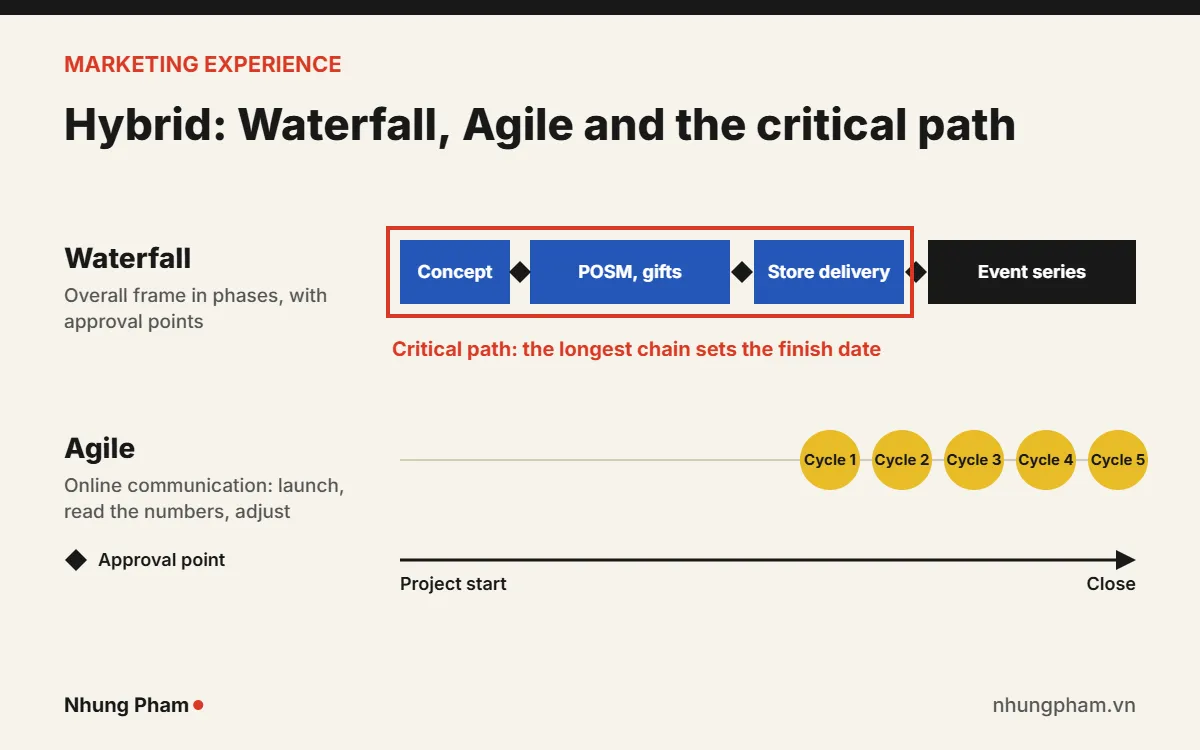
For a project with this many workstreams, I combine the two. This is called a hybrid approach. Waterfall runs in phases, and each phase has clear outputs and an approval point. Agile works in short cycles: you look at feedback and keep adjusting.
| Approach | How it works | Best for | In the event series |
|---|---|---|---|
| Waterfall | Phases, each with outputs and an approval point | Work with fixed deadlines and several levels of approval | Concept, POSM, the event schedule at each location |
| Agile | Short cycles, adjusted based on feedback | Work that needs fast testing and adjusting | Online communication, advertising |
| Hybrid | The overall frame runs in phases; the parts that need testing run in cycles | Projects with workstreams of different kinds | The whole event series |
Schedule around the critical path
The critical path is not a management approach; it is a scheduling technique. It is the chain of dependent tasks with the longest total duration, and it sets the earliest date the project can finish.
Not every long task sits on the critical path. In my event series, the chain “concept sign-off → POSM and gift production → delivery to stores” was the longest, so I started it first and watched it most closely. A day late on this chain is a day late for the whole project.
Break down the work and estimate time
Picture each major stage of the project, then split each stage into smaller tasks. This is a WBS (work breakdown structure). Ask the specialists in each workstream to help, because they do the work and know it better than you.
If you are accountable for the whole project, you need to know the key items in each workstream and when they will be done.
Estimate time at three levels: optimistic (O), most likely (M) and pessimistic (P). This is three-point estimating (PERT). Estimated duration = (O + 4 × M + P) ÷ 6. Base the three levels on the real conditions and risks of each task.
For example, printing a batch of POSM: optimistic 5 days, most likely 7 days, pessimistic 12 days gives an estimate of about 7.5 days (illustrative). It is an estimate, not a commitment. Supply or weather are outside your control, so delays can happen.
Project risk management: always have a Plan B
The biggest risk I faced was communication not working and shoppers not coming to the events. I handled it in two ways:
- I asked attendees which channel told them about the event, then moved budget to the channels that brought the most people.
- I asked how they usually hear about events like this, then tested new advertising channels.
After several rounds of testing, I found the channels that worked and the communication budget needed to hit the KPI. Since then, I always write risks into a register at the start of a project, with warning signs that tell me when to switch to Plan B. The X% and day T in the table depend on the project; there is no universal number:
| Risk | Likelihood | Impact | Warning sign | Prevention | Plan B | Owner |
|---|---|---|---|---|---|---|
| Low event turnout | Medium | High | Pre-registrations below X% of target by day T | Survey channels from the first wave | Shift budget, test new channels | Marketing, in-house digital |
| Late POSM or gifts | Medium | High | Artwork approval more than T days behind schedule | Order early, add buffer time | Reuse existing POSM, reschedule later locations | Agency, supply chain |
| Slow legal approval | Low | High | No response T days after submission | Send to Legal as soon as the concept is signed off | Delay the programme announcement | Legal |
When someone asks for extra work mid-project
When the CEO or Sales wants to add something while the project is running, I follow three steps: assess the impact on KPIs, budget and schedule; get approval from the person accountable; update the charter. This protects the agreed scope while staying flexible.
Delegate to the right people, and don’t micromanage
- The name of the method matters less than staying on schedule. If something is late, find a fix or switch to the backup option.
- Let people do what they are good at, and expect them to finish what they take on. Make the working culture and each party’s responsibilities clear at the start.
- With many workstreams, appoint a lead for each. You manage the leads to keep track of progress.
- The project lead shouldn’t get too involved in design. Check that the design carries the right message and follows the brand guidelines; leave the creative work to the creative people.
Track spending
Compare actual spend with the budget at every milestone. Pay the agency against accepted milestones, not all at once.
Step 4: How do you measure, report and close the project?
Measure at each milestone, report regularly to every party, and finish with a review. On a long project, measuring at each milestone shows whether you are on schedule and on track for the KPIs. Keep what works; for what doesn’t, find the cause and change it.
No plan is perfect from day one. I can only set up the frame and the destination; the route gets adjusted along the way.
Reporting to stakeholders
Report weekly, monthly or after each wave, as agreed at the start. When something goes wrong, tell the budget owner and the main parties right away so they can decide in time.
Each of my reports has four lines: KPIs against target, money spent, open risks, decisions needed.
The project review and closing
This is what makes the next project more efficient in results, cost and people. After the project ends, hold a short meeting around three questions: what went well, what didn’t, what we’ll change next time.
In that meeting, compare actual results with targets, actual spend with the approved budget, the performance of each channel, and why you did or didn’t hit the targets. If a KPI is about awareness or behaviour, write down how and when it was measured.
Then sign off the deliverables, make the payments, and archive the files and photos. Write down the lessons and the working frameworks that worked, so the next project saves time and effort.
How do you apply this alone or with a small team?
Still follow all four steps, just lighter: a one-page charter, a three-person RACI chart, and one Google Sheets file to track progress and spend. If you don’t have an agency, treat each person on the team as an “agency” responsible for one workstream.
Download the marketing project management template
Five sheets: a 12-item charter, a RACI chart (checks that each task has exactly one A), a weighted KPI score (calculates one project score), a risk register (calculates risk scores), and a schedule and spend tracker (calculates PERT estimates and remaining budget). Pre-filled with the illustrative event series example; works in Excel or Google Sheets.
Real example: how was the battery trade-in event series managed?
About 20 events in 6 months ran because of a clear charter, a RACI chart agreed from the start, and a different way of managing each kind of workstream. Here is a summary of what I applied:
| Principle | How it worked in the event series |
|---|---|
| Weighted KPIs | Attendance was the primary KPI (highest weight), social media impressions the secondary KPI; the wrap-up gave one combined score |
| The budget owner signs off RACI | The CEO approved the charter, budget and RACI chart; the RHQ advised on strategy and communication |
| Many workstreams in parallel | 8 workstreams, run as a hybrid: the concept → POSM → delivery chain was the critical path, online communication ran in cycles |
| Always a Plan B | When shoppers didn’t come, survey the channels, shift the budget and test new channels |
| Measure at each milestone | Report after each wave of events, adjust channels and budget for the next wave |
Figures are for illustration only, not actual data.
The lesson: a project with many moving parts doesn’t need a perfect method. It needs every party to work from the same charter and to know exactly who decides what.
If you are planning the whole year, read my annual marketing planning process in 6 steps. It shows how a project like this fits into the year’s plan and budget.
FAQ about marketing project management
What does a marketing project manager do?
They turn a goal into a charter with weighted KPIs, split the roles with a RACI chart, brief and manage agencies, run the parallel workstreams, track risks and spend, and report results at each milestone until the project is closed.
What is a project charter in project management?
A project charter is a short, formal document that confirms a project exists and gives the project lead authority to start. For a marketing project it covers the business need, goals and weighted KPIs, scope, stakeholders, budget and other constraints, risks, milestones, success criteria and who approves it. Unlike a marketing plan, which covers a whole year or brand, a charter covers one project.
What is a RACI chart in project management?
A RACI chart, also called a RACI matrix, lists each task and shows who is Responsible (does the work), Accountable (owns the outcome, only one per task), Consulted and Informed. In a marketing project it stops work falling through the gaps and sends updates only to the people who need them.
Is Waterfall less effective than Agile for marketing projects?
Not always. Waterfall suits work with fixed deadlines and several approvals, such as an event concept or POSM production. Agile suits work that needs fast testing, such as online ads. Most marketing projects with several workstreams work best as a hybrid of the two.
Conclusion
Marketing project management doesn’t need expensive software or a perfect method. A clear charter, a RACI chart signed off by the person paying, the right approach for each workstream and the habit of measuring at each milestone are enough to keep many tasks running without chaos.
If you’re running a project with many moving parts and want to compare notes on splitting roles or building a RACI chart, feel free to message me on LinkedIn.
References: TechTarget – What is a project charter? · Wikipedia – Project charter · IPA – BetterBriefs Project (13 October 2021) · Project Management Institute, PMBOK Guide (RACI, WBS, three-point estimating). Everything else is from the author’s own work experience.

I’m Nhung Pham, a marketer based in Hanoi, Vietnam, with 9 years of experience at Panasonic, Thien A Group, Vinalink Media and Apollo English. I work on both strategy and execution, from trade marketing and e-commerce to AI in marketing. This blog is where I write down what I understand and what I have done in marketing.