
This is the English version of my article. Đọc bản tiếng Việt.
The annual marketing planning process comes down to 6 steps: review where the business stands, set business goals and split the budget, choose target customers, positioning and the 4Ps, lay out the year’s calendar, execute, and review. The year-end review then feeds next year’s plan, so it is a loop, not a file you finish and file away.
I wrote this from the way I built annual plans as a marketer at a foreign consumer-goods (FMCG) company in Vietnam. It is for in-house marketers preparing next year’s plan. If you run a small business, I have added notes on lighter ways to do the main steps. At the end there is an annual marketing plan template in Excel you can download and fill in.
Key takeaways
- Start with “where are we now”: market share, product portfolio, channels, customers, competitors, the macro environment, SWOT and market position.
- Growth targets should separate growth from selling more units, from price, and from product mix.
- Split the budget into maintaining sales, growth and branding, plus a contingency reserve with clear rules for using it.
- Decide target customers, positioning and all 4Ps (product, price, place, promotion) before scheduling ATL and BTL activities for the year.
- Illustrative example: keeping trade promotions stable all year so dealers stop stockpiling, and measuring sell-out, not just sell-in.
What is the annual marketing planning process?
The annual marketing planning process means answering 5 questions in order: where are we now, where do we want to be, what routes could get us there, which route is best, and how do we make sure we arrive. This framework comes from the textbook Strategic Marketing Management by Wilson and Gilligan. The 6 steps below are how I turn those 5 questions into concrete work for one year.
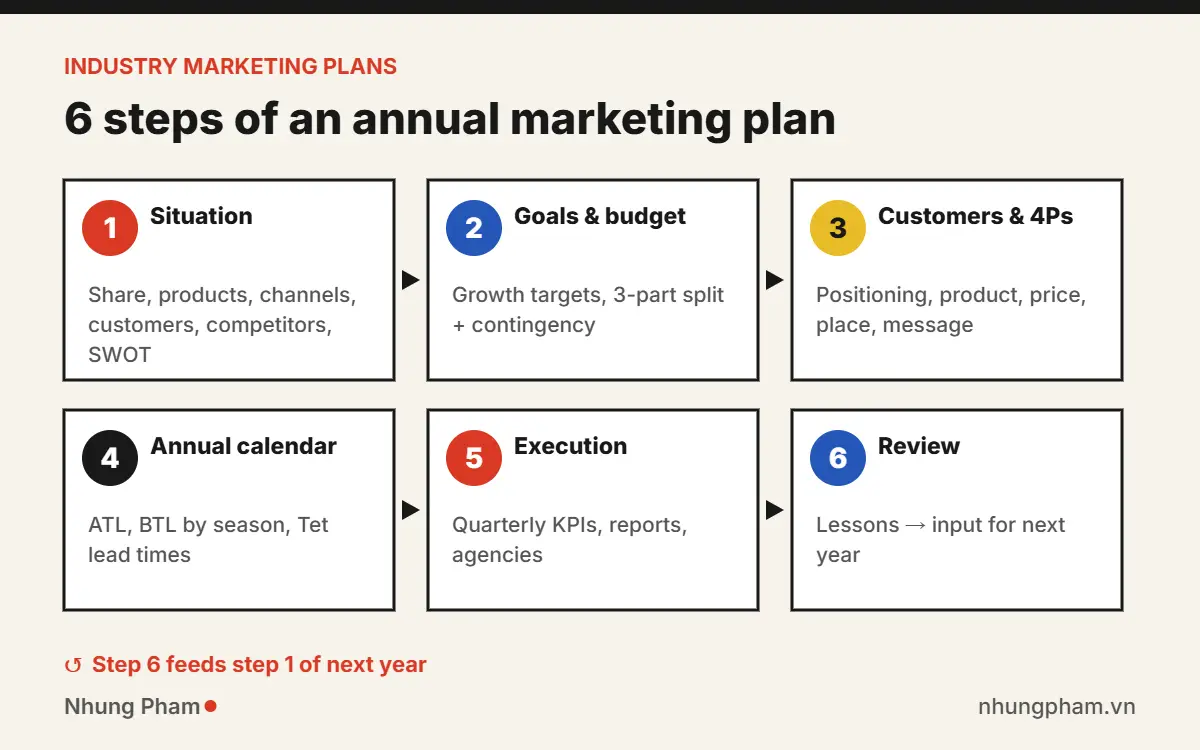
| Step | Question to answer | Output |
|---|---|---|
| 1. Situation | Where does the brand stand versus the market and competitors? | Analysis, SWOT/TOWS, market position |
| 2. Goals and budget | How much should we grow, and how is the marketing budget split? | Business goals, marketing goals, 3-part budget + contingency |
| 3. Customers, positioning and 4Ps | What do we sell, to whom, at what price, where, and with what message? | Target customers, positioning, 4P decisions, content of each programme |
| 4. Annual calendar | What happens when? | ATL and BTL calendar by season |
| 5. Execution | Who does what, what are the KPIs, how do we report? | Detailed plans, quarterly KPIs, project folders and reports |
| 6. Review | Did we hit the targets, and why? | Lessons learned, input for step 1 next year |
Step 1: Where does your business stand now?
Before setting any number, you need an honest picture of the current situation. The output of this step is the 2–3 biggest problems or opportunities, backed by data; the “what we will do” part belongs to steps 2 and 3.
Market share and positioning
Market share can be confirmed through research firms such as Nielsen or Kantar. Without that data, you can run market surveys and store checks to estimate share of shelf. Note that share of shelf measures presence on the shelf; it is not the same as sales share. Companies may also have internal ways to measure it.
Write down your current positioning: how customers see the brand versus competitors, and whether that positioning still fits the company’s business strategy.
Product portfolio
- Hero products: the core products you want to push in this period.
- Brand-defining products: they hold the price level and personality of the brand, for example a premium line with a higher price and better packaging. They may sell in small volumes, but they show the brand’s credibility and technology.
- Maintenance products: products that already sell in large volumes and cover most of the reachable market.
- For each product, note its segment, price and key features.
Differentiation, messaging and brand assets
- How does the product currently differ from competitors?
- What key message are you using now, and do customers remember it?
- Which brand assets do customers recognise: colours, logo, slogan, sound, characters…
Channels, customers, competitors and environment
- Sales channels: which channels perform well and need protecting and growing? Which are weak? Which are new?
- Customers: what are their insights and pain points? Which pain points has the brand solved? Is there a new insight worth using, or does the old one still work?
- Competitors: each competitor’s portfolio, prices, positioning and strategy. Who are your direct competitors? What are they about to do, and how will they react if you change?
- Macro environment: do domestic or foreign policies affect the business? Is demand for the product changing?
- Last year’s programmes: which programmes hit or missed their KPIs, how much did they cost, and why? This comes straight from last year’s step 6.
SWOT, market position and brand health
Run a SWOT analysis: strengths, weaknesses, opportunities, threats. Don’t stop at the list. Pick the 2–3 most important points in each box, then pair strengths with opportunities and weaknesses with threats to find directions (the TOWS matrix).
From there, define your market position: leader, challenger, follower or nicher. Your position shapes how you play. A leader expands the market and defends share (I wrote separately about strategy for market leaders, in Vietnamese). A challenger picks the right competitor and attacks its weak points. Followers and nichers focus on the part of the market they can hold.
If the company runs an annual brand health or customer behaviour survey, use it to assess last year’s marketing results and guide next year. I explain how to read survey results in What is a brand health check (in Vietnamese).
If you run a small business: you don’t need a big survey. Start from sales, margin by product or channel, costs and last year’s programme results, then ask a few loyal customers directly why they buy.
Step 2: How should you set business goals and split the marketing budget?
Marketing goals follow business goals. You need to know how much the company wants to grow, and where, before you know what the marketing money should do.
Business goals
Look at the category growth rate, your own growth history (CAGR, compound annual growth rate), inflation and competitors’ growth. Only then set the growth target.
Separate sales value, units sold, net selling price and product mix. For example, if customers switch to a pricier line, sales value rises even when no single product’s price changes. This keeps you from mistaking growth from price or mix for growth from selling more. In my experience, the category director and sales manager usually agree on this with marketing.
- What is the growth target in %? How much sales value does that mean?
- How much should each product group grow? Are there new product launches?
- How much should each channel grow? Are there new channels to open?
Where will growth come from?
Before splitting the money, choose where growth will come from: more outlets, selling more in existing outlets, new products or new channels. Base the choice on step 1 data, and be clear which part marketing is accountable for. If you have 2–3 options, compare them on cost, expected impact, feasibility and risk before choosing. Once the growth route is set, the budget can go to the right places.
If you run a small business: with a small budget, back one growth route and see it through rather than spreading money thinly.
Marketing budget
- What % of expected sales is this year’s marketing budget? How much money is that? Up or down versus last year?
- Which marketing activities are essential to maintain sales? How much do they cost?
- After those essentials, how much is left for growth and how much for branding?
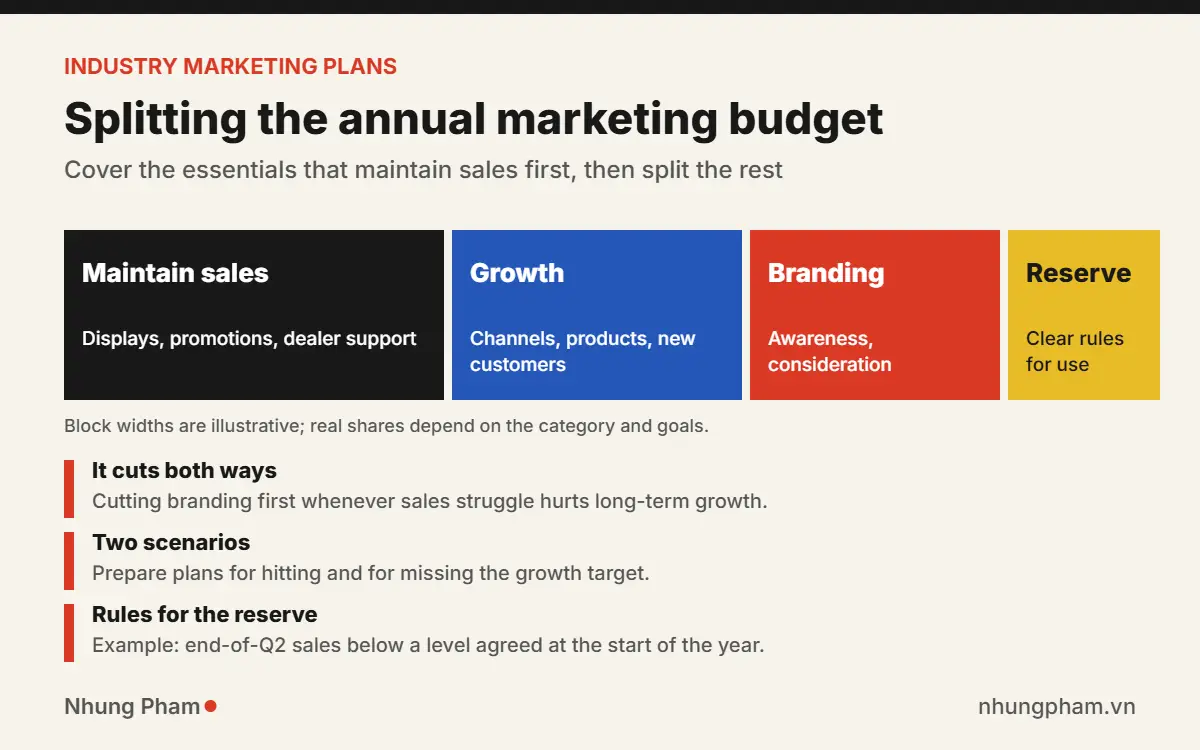
This split protects sales support, but it cuts both ways. If you cut the branding budget first every time sales get difficult, long-term growth suffers.
For branding, prepare 2 scenarios: hitting and missing the growth target. Separately, keep a contingency reserve in case sales fall short. State when it can be used and who approves it, for example if sales at the end of Q2 are below a level agreed at the start of the year.
When sales fall short, find the cause before spending: out-of-stocks, low distribution and weak demand need different fixes.
Marketing goals
Based on the budget split and the channels you will spend in, set marketing goals for each group. First, separate three groups of activity:
| Group | What it does | How to measure |
|---|---|---|
| Sales support | Protects current sales: displays, promotions, dealer support | Sales, plus programme-specific metrics such as numeric distribution and promotion redemption rate |
| Growth | Opens new channels, products or customers | Sales, number of new channels, new customers reached, conversion rate |
| Branding | Builds long-term awareness and brand image | Awareness surveys, consideration, brand health metrics |
Every goal needs a number and a deadline, and goals should be ranked at the start of the year so you know what to cut when you must. For a compact way to review budget and measurement, see the 5Ms model (Mission, Money, Message, Media, Measurement; in Vietnamese).
Step 3: How do you choose target customers, positioning and the 4Ps for the year?
Target customers and positioning for the year
From the 2–3 problems and opportunities in step 1, decide the main customer group for the year and the brand positioning: keep it or adjust it. At the consumer-goods company where I work, this is decided in a meeting between marketing, the category director, the sales team and the regional headquarters. The same meeting decides which models are the core models, which are new launches and which should be phased down.
The 4Ps: product, price, place, promotion
Positioning only becomes action once it is turned into the marketing mix, usually called the 4Ps. For each P, answer:
- Product: which models are core, which are new, which are being phased down? Any changes to packaging or pack sizes?
- Price: any changes to selling price, dealer discounts or promotional prices? At my company, pricing in traditional channels is owned by the sales manager. E-commerce, however, is developed and run by marketing, so marketing sets the price there: we analyse cost of goods sold (COGS), operating costs and competitor prices, then balance selling price, marketing cost and profit.
- Place: which channels and outlets will you add? How will displays and stock deliveries work?
- Promotion: what to say, to whom, and through which media (see below and step 4).
All four Ps must tell the same story. For example, a product positioned as premium should not be heavily discounted.
Content of each programme
Before writing the content of each programme, answer three questions. They decide whether every activity in the year tells the same story.
- Who is the customer for this activity? What pain point do they have? How will you solve it?
- What is the brand’s point of difference? What key message and brand values are you pursuing?
- What are the brand assets? How will customers recognise the brand through all of them, and how will you use them consistently in every activity?
In a multinational, this is where you work directly with the Regional Headquarters. The aim is to keep activities in Vietnam aligned with the group’s direction and with the business direction for the Vietnamese market.
If you run a small business: the person to align with at this step is the owner or the management team, and you usually decide all 4Ps yourself. Without an agency, you can do the work yourself or hire freelancers for each task in step 5.
For campaigns, ask: what customer problem does each campaign’s key message solve? How does it set the brand apart from competitors?
Illustrative example: when dealers stock up to hit bonus targets
This is a problem I faced in consumer-goods marketing. When there is a promotional gift, customers and dealers buy in bulk to get it. Inventory piles up, and when the next period has no promotion, they stop buying.
The scenario below is illustrative, not an exact account or real figures, to make the point easier to picture.
Say we run a Tet (Lunar New Year) promotion. Dealers buy heavily to reach the bonus target. But after the Tet season, orders drop sharply.
The reason is that wholesalers ordered far more than the market could absorb, just to get the best price. Market prices get dragged down and stock builds up at dealers. The company’s sell-in plan and inventory both suffer; this is a big loss.
After that, we turned promotions into accumulation programmes running all year, or for half a year but continuously. Dealers no longer rushed to grab deals and bought what they could actually sell.
The result: steady sales growth and no more dumping. A transparent sales policy also made dealers much happier.
To check whether this works, track sell-out, dealer inventory, how often dealers reorder and market prices after the programme.
| Principle | How to apply it |
|---|---|
| Stable promotions all year | Turn promotions into accumulation programmes that run all year, or for half a year but continuously, and avoid changing them mid-way. Sales arrive as planned, and partners stop rushing for deals and work steadily for the long term. |
| Keep a flexible reserve | Set aside a budget for when a competitor launches a big promotion, instead of breaking the whole year’s plan. |
| Measure the right thing | Track sales to end consumers (sell-out), not only dealer purchases (sell-in). If, in the same period and scope, sell-in rises but sell-out does not rise accordingly, check the stock in the channel. |
Lesson: a good promotion keeps sales steady and builds partner trust; it does not create a sales spike that leaves a warehouse full of stock.
Step 4: How should you lay out the year’s marketing calendar?
Plan by year, paying attention to weather, selling seasons and partners’ major sales events. For many consumer-goods categories in Vietnam, Tet is the most important selling season. Work backwards from Tet for the production of POSM (point-of-sale materials), gifts and stock deliveries.
Then schedule ATL and BTL activities for the year. ATL (above the line) is mass media such as TV, outdoor and broad-reach digital advertising, usually covering the year’s major campaigns. BTL (below the line) reaches buyers and partners directly: dealer activities, promotions, sales contests, conferences, trade marketing, e-commerce. This is a common split in consumer-goods companies; some companies treat digital as a separate group.
For activities in traditional trade, you can also use the checklist in my article on general trade market checks (in Vietnamese) to plan field visits.
Step 5: How do you execute the marketing plan without drifting off course?
- Write a detailed plan for each activity. Break the overall budget and KPIs down to each activity, and by quarter so they are easier to track and adjust. For each programme, record the metric, baseline, target, measurement period and owner.
- Meet stakeholders to agree budgets, KPIs and the rollout plan. Assign tasks and responsibilities to each party.
- Select agencies through pitches (if any) for each project; set KPIs for agencies and other parties, giving them only metrics within their control.
- Create a folder for each project with report files and project management files.
- Report weekly, monthly, quarterly and yearly on each project to stakeholders.
- For projects with many new elements, test and evaluate continuously to find what works best.
- Close each project with a report: results versus KPIs, strengths, weaknesses, lessons and insights.
If you run a small business: a simple Excel file tracking KPIs by month is enough. What matters is reviewing it regularly and noting why targets were or were not met.
Step 6: When and why should you review the marketing plan?
Review marketing results every quarter and every business period, and adjust or add activities when needed. At the end of each quarter, decide which programmes to keep, scale up, fix or stop, based on causes and data. The review is the input for next year’s step 1, so don’t let the year-end report become a file you submit and forget.
Annual marketing plan template: how to download and use it
I turned the 6 steps into an Excel marketing plan template built on the 5-question framework. Five sheets cover all 6 steps, with guiding columns and example rows from a consumer-goods business using illustrative numbers. Delete the example rows and fill in your own figures.
Annual marketing plan template (Excel)
5 sheets: Situation · Goals and budget · Customers, positioning and 4Ps · Annual calendar · Execution and review. All figures in the file are illustrative.
Further reading on the blog
To go deeper into parts of the plan (all in Vietnamese): measuring brand health in What is a brand health check; choosing an approach by market position in marketing strategy for market leaders; testing your customer assumptions with Byron Sharp’s 7 marketing principles.
Frequently asked questions about annual marketing planning
How do you create an annual marketing plan?
There are 6 steps: analyse the situation, set business goals and split the budget, choose target customers, positioning and the 4Ps, lay out the annual calendar, execute, and review. The review feeds next year’s plan.
What percentage of sales should the marketing budget be?
There is no single number for every category. Use expected sales and last year’s spend as a reference, then recalculate based on the cost of the growth priorities you chose. Then split it into maintaining sales, growth, branding and a separate contingency reserve.
What minimum data does a small business need to build a marketing plan?
At minimum: sales, margin by product or channel, marketing costs and the results of last year’s main programmes. With these numbers you can see where the money should go.
How often should you review a marketing plan?
Review it every quarter and every business period, plus a full review at year end. Breaking KPIs and budget down by quarter helps you spot gaps early and adjust.
Conclusion
A good annual marketing plan starts with the truth about where you are, has clearly separated goals and a budget with a contingency plan, and is measured in the right places throughout the year. You don’t need a perfect plan in year one; you just need each review to make next year’s plan a little better.
If you are building next year’s marketing plan and want to talk through any of these steps, feel free to message me. I’d love to hear how you are approaching it.
References: Wilson, R.M.S. & Gilligan, C. (2005). Strategic Marketing Management: Planning, Implementation and Control, 3rd edition. Elsevier Butterworth-Heinemann (5-question framework, TOWS matrix, market positions after Kotler). Everything else is from the author’s own work experience.

Mình là Nhung Pham (Phạm Thùy Nhung), làm marketing ở Hà Nội với 9 năm kinh nghiệm tại Panasonic Energy Việt Nam, Thien A Group, Vinalink Media và Apollo English. Mình làm cả chiến lược lẫn thực thi, từ trade marketing, thương mại điện tử đến ứng dụng AI trong marketing. Blog này là nơi mình ghi lại điều đã làm, đã học và đã đọc. Đọc thêm về mình · Liên hệ trao đổi